
2026-07-01
Split Bearings: Structure, Features & Industrial Applications
Introduction to Split Bearings
Split housed bearing units are high-performance industrial components engineered with advanced international manufacturing technology. They integrate the mechanical strengths of traditional rolling bearings and the unique disassemblable split design of plain bearings. Featuring a compact structure, adjustable internal clearance, ultra-fast assembly and disassembly, and low maintenance requirements, split bearings are the ideal solution for confined shaft positions where integral bearings cannot be installed or replaced. Their most prominent advantage is enabling bearing replacement without complete equipment dismantling, which significantly reduces production downtime and maintenance costs for continuous industrial lines.
1. Complete Structure of Split Bearings
1.1 Standard Core Component Layout
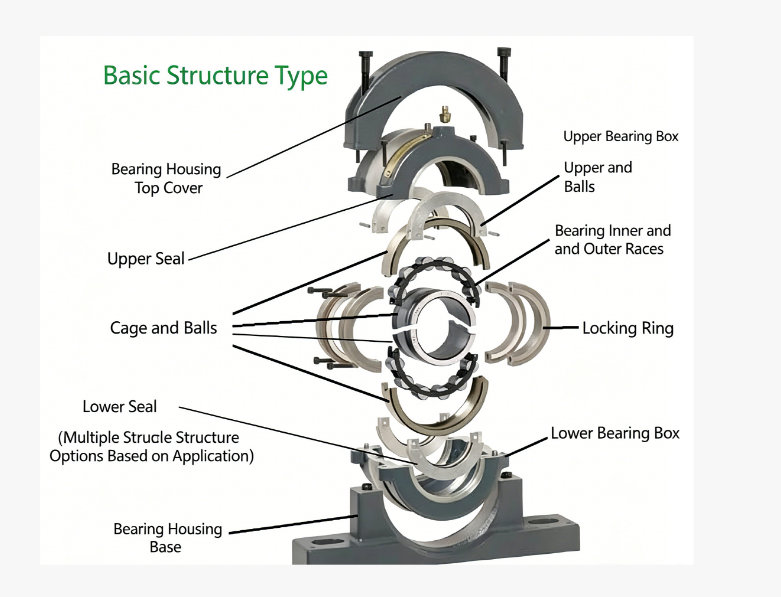
A complete split bearing assembly consists of the following standardized split components:
1. Bearing Housing Base & Top Cap
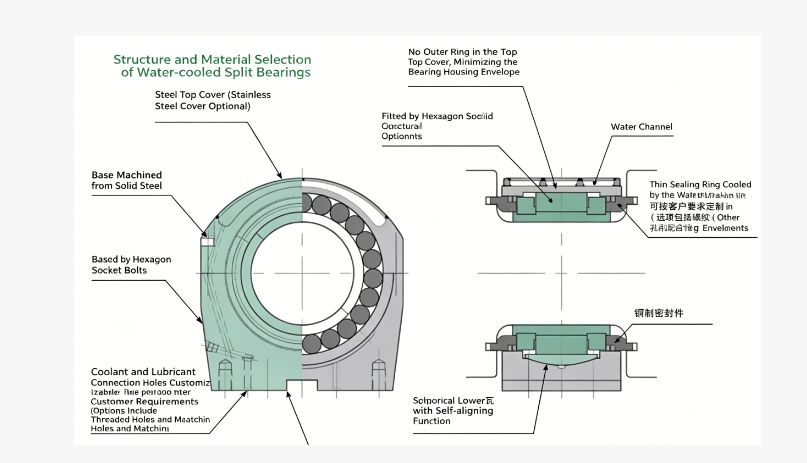
Manufactured from high-strength cast steel or cast iron, the split housing is fastened by hex socket bolts. Custom water-cooled housings are equipped with internal cooling channels to adapt to high-temperature working conditions.
2. Split Inner & Outer Rings
Both inner and outer rings are radially split into two symmetrical halves. Precision positioning shoulders ensure high coaxiality after clamping. Lock rings are installed on both sides of the split inner ring to prevent separation and relative slippage on the shaft journal during operation.
3. Split Cage & Rolling Elements
The segmented split cage isolates spherical or cylindrical rollers to avoid mutual friction. The rolling element assembly supports heavy combined radial and axial loads, ensuring stable rotary performance under heavy-duty conditions.
4. Double-Side Sealing Assemblies
Multiple sealing solutions including labyrinth seals, brass flinger seals, and oil seals are available to block dust, cooling water, and debris, while retaining internal lubricant grease. Integrated grease nipples support convenient on-site re-lubrication and daily maintenance.
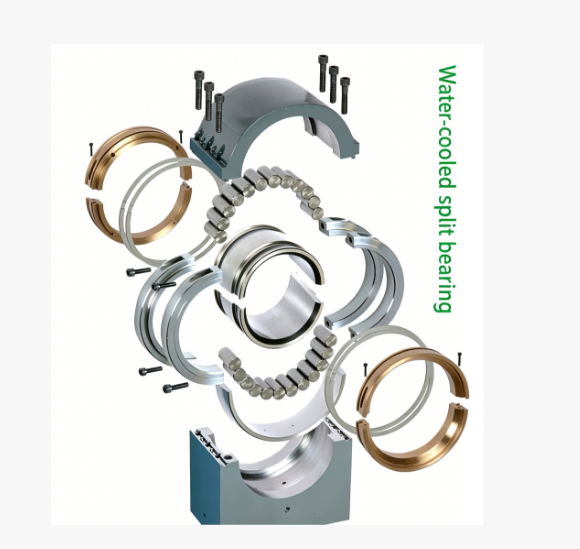
5. Optional Water-Cooled Structure
Custom internal water channels inside the bearing housing effectively dissipate radiant heat, allowing continuous stable operation under ambient temperatures up to 180°C.
1.2 Three Main Mounting Types
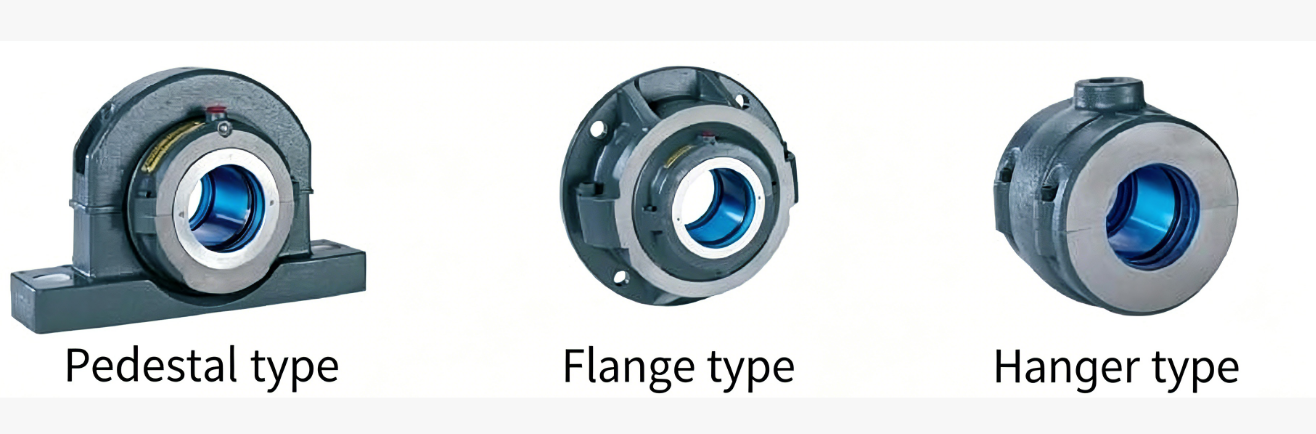
Split bearings are available in three mainstream mounting styles to fit diverse installation scenarios:
• Pillow Block Split Bearing
Vertical base design, the most widely used type for horizontal long transmission shafts.
• Flange Split Bearing
Square flange structure for compact fixed installation on equipment side plates and vertical mounting surfaces.
• Hanger Split Bearing
Suspended installation design, suitable for overhead conveying rollers and vertical transmission shafts.
1.3 Axial Positioning Configurations
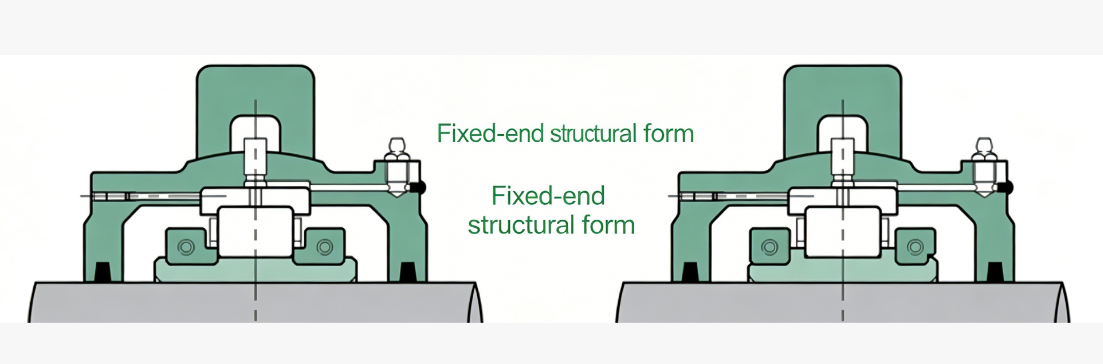
For long industrial shafts affected by thermal expansion and contraction, split bearings adopt a professional fixed-floating paired layout:
• Fixed End Bearing
Limits axial shaft movement, bears bidirectional axial loads, and locks the overall axial position of the shaft system.
• Floating End Bearing
Allows free axial sliding to compensate for thermal expansion and contraction of long shafts, eliminating thermal stress damage. In practical applications, one fixed end bearing is matched with multiple floating end bearings for long roller lines.
2. Unique Advantages of Split Bearings vs Integral Bearings
1. Minimal Maintenance Downtime
The fully separable split structure allows direct installation and removal from the side of the shaft. There is no need to disassemble couplings, gears, impellers, or surrounding mechanical parts. Only basic hex socket tools are required, perfectly adapting to narrow and confined maintenance spaces and greatly reducing production downtime.
2. Full Internal Inspectability
By simply removing the housing cap, split outer ring, and cage, all rollers, raceways, and seals can be fully exposed for visual inspection. Maintenance teams can accurately judge component wear status, predict bearing service life, and arrange preventive maintenance to avoid unplanned equipment shutdowns.
3. Strong Adaptability for Harsh Heavy-Load Environments
Split bearings feature low rotational resistance and stable operating performance. The optional high-temperature resistant version supports continuous operation up to 180°C. They are highly suitable for low-speed, heavy-load, high-impact working scenarios with heavy dust, water splash, and poor sealing conditions.
4. Built-In Self-Aligning Performance
The spherical outer housing seat can automatically compensate for shaft misalignment and slight shaft bending, reducing the precision requirements for shaft machining and equipment assembly.
3. Wide Industrial Application Fields
As mature and field-proven heavy-duty mechanical components, split bearings are widely applied in global heavy industries:
3.1 Iron & Steel Metallurgy (Core Application Industry)
•Continuous casting segments, straightening rollers, and slab cooling beds
•Hot and cold rolling mill transmission shafts and long roller lines
•Furnace conveying rollers, transfer trolleys, and turnover equipment
•Rotary converters and ladle transport support shafts
3.2 Cement & Building Materials Industry
Widely used for rotary kiln support rollers, dryer drums, ball mill intermediate drive shafts, and plate feeders.
3.3 Mining & Bulk Material Conveying
Ideal for belt conveyor head and tail pulleys, bucket elevators, stacker-reclaimers, and crusher intermediate support shafts.
3.4 Other General Heavy Industries
Power plant high-temperature induced draft fans, waste incinerator rotary drums, papermaking dryer rolls, marine intermediate drive shafts, chemical conveying rollers, and large wastewater treatment agitators.
4. On-Site Application Cases
4.1 Continuous Casting Segment Long Shaft
Traditional integral bearings require complete roller disassembly for replacement. With paired fixed and floating split bearings, single bearing replacement can be completed quickly without dismantling the entire roller assembly, greatly improving maintenance efficiency.
4.2 Steel Mill Long Cooling Bed Roller Line
Long multi-support roller lines are equipped with dozens of bearing points. Split bearings support independent inspection and individual replacement of damaged units without shutting down the entire production line.
4.3 Rotary Kiln & Converter Heavy Supports
Working conditions feature high temperature, heavy shock loads, and limited overhaul space. Water-cooled split bearings effectively resist thermal radiation damage and simplify periodic maintenance work.
Conclusion
Split housed bearings perfectly solve the core maintenance difficulties of long, hard-to-disassemble transmission shafts in heavy industry. Their separable split structure, diverse mounting options, professional fixed-floating axial matching, and customizable high-temperature water-cooled design make them irreplaceable core components for low-speed, heavy-load continuous production lines. For equipment operators pursuing lower maintenance costs and higher production uptime, split bearings are a cost-effective, stable, and reliable heavy-duty transmission solution.
SEO Keywords: split bearings, split housed bearing unit, split roller bearing, fixed floating split bearing, water cooled split bearing, steel mill split bearing, conveyor split bearing, heavy duty split bearing
 |  |
 |  |


